Showing posts with label Constitution. Show all posts

Saturday, 27 February 2016

British government holding back British Bill of Rights & Responsibilities until after the EU Referendum

The British government are holding back their British Bill of Rights & Responsibilities - a new law that would replace the EU Human Rights Act and the 1689 English Bill of Rights - until after the EU referendum to avoid being slapped down over attempts to curtail the jurisdiction of the EU Court of Injustice.


The Human Rights Act - often referred to as the criminal's charter - brought into force the European Convention on Human Rights. The ECHR gave some of the human rights already enjoyed in England by the Bill of Rights, Magna Carta and Habeas Corpus (amongst others) legal protection under EU law and gave the EU Court of Human Rights and EU Court of Injustice the right to overrule our own courts when interpreting its provisions. In addition to what are considered human rights in the commonly accepted definition of the term, it gave new legal rights to criminals, illegal immigrants, hate preachers and terrorists that can be used to escape punishment and deportation.

The EU has already admitted to holding back new legislation and a budget review until after the EU referendum because they don't want to help the leave campaign and now it seems the British government are doing the same. Irrespective of the fact that we don't need a British Bill of Rights to replace the perfectly good Bill of Rights we've had for the last 328 years, the British government shouldn't be manipulating the legislative process for their own political campaigns.

The rights we have from our own constitution


Bill of Rights 1689

  • Only Parliament can make or repeal laws
  • Only Parliament can levy taxes
  • All subjects have the right to petition the Crown
  • Armed forces are answerable to Parliament
  • Members of Parliament must be elected in free elections
  • Immunity from prosecution for libel for Members of Parliament
  • No cruel or unusual punishments or excessive bail
  • The right to trial by jury
  • No fines or forfeitures without conviction
  • Parliament will sit on a regular basis
  • The Crown is not above the law

Magna Carta 1215

  • The right to trial by jury
  • No fines or forfeitures without conviction
  • The state cannot use force against you without legal authority

Habeas Corpus 1679

  • Prisoners have a right to appear before a judge
  • Prisoners can't be moved to a different prison or out of the country to avoid due process

Petition of Right 1627

  • Only Parliament can levy taxes
  • The Crown can't demand that you lend it money
  • Armed forces don't have a right to enter your home and demand hospitality
  • Soldiers have to obey the law of the land even when martial law is in effect

The "rights" we don't get from our constitution


  • The right to break into the back of a lorry and illegally enter the country
  • The right to preach hatred and intolerance on our streets
  • The right to free housing and benefits without ever having to pay a penny in taxes
  • The right to compensation for hurt feelings
  • The right to special treatment because of your age, gender, sexuality, disability, race or religion

Monday, 6 August 2012

House of Lords reform: a real alternative


With Lords "reform" all but dead in the water, its time for UKIP to take the initiative on the subject.

The Liberal Party first broke the House of Lords at the turn of the last century with the passage of the Parliament Act which removed the ability of the House if Lords to stop bad legislation by allowing the Commons to pass laws with the Lords' agreement if they disagreed three times in one Parliament.

The Labour Party broke it even more by removing a large number of experienced, independently-minded Peers from the upper house and replacing them with career politicians appointed on the basis of their usefulness and loyalty to their party.

The Lib Dems tried to break it even more not long ago by trying to replace it with an elected House of Lords which would be as sleaze-ridden, impotent and whipped to within an inch of is life as the Commons. The attempt was scuppered by the Tories not so much out of any ideological standpoint but because Lords are more "their sort of people".

UKIP has conflicting policies on Lords reform which need to be addressed as part of the ongoing policy review that has seen the thankfully short-lived enforced Britishness policy superceded by the new devolution policy that's going to be unveiled at the next party conference which would see the House of Lords replaced with an elected federal British Parliament.

In an ideal world we would keep the House of Lords even with a fully federal government but in this day and age the electorate is unlikely to accept more layers of government no matter what the benefits are. Losing the House of Lords is unfortunate but it's a price worth paying for real national democracy.

Support for devolution is overwhelming in all four member states of the UK and given the opportunity to turn that support into votes, most would vote yes to turning the British Parliament into an English Parliament and the House of Lords into an elected federal British Parliament. However, you should always have a fallback position in case things don't turn out as expected. If the House of Lords did continue to exist after the creation of an English Parliament then how can the system be reformed to make it work better?

The main problem with the House of Commons is that party politics gets in the way of the democratic process. It is a rare occurrence for an MP to defy the party whips and those that do are punished severely, losing jobs and facing suspension or even expulsion from their party for doing so. The fraud and sleaze is still a problem even after being caught with their fingers in the till but it doesn't generally prevent the democratic process from running it's course. An elected House of Lords would be subject to exactly the same systemic failures that the Commons is and far from improving democracy, it would instead take away any semblance of opposition to the Commons for much of the time because it is inconceivable that the electorate would elect a Tory majority to the Commons and a Labour majority to the Lords and staggering the elections would only produce an effective opposition for half a term - two years - at best. Imagine Tony Blair's 10 year rule without the House of Lords stopping internment, investigating the illegal war against Iraq, protecting the right to trial by jury, opposing control orders and banning the use of evidence obtained through torture. With a Labour majority in the upper house most of our centuries-old rights and liberties would have been abolished and the England that Orwell warned of in 1984 would be a lot closer.

So if the answer isn't electing the upper house, how can it be made more accountable and how can it be done whilst sticking to UKIP's principles? The answer lies in the direct democracy policy introduced during Lord Pearson's brief stint as leader where Swiss-style referenda would be held on contentious issues. Any piece of proposed legislation that can cause the Commons and Lords to disagree to the extent that no compromise can be found three times in less than a year surely qualifies as contentious so why should it be left to 600 politicians to decide what's right when a thousand peers say they're completely wrong and that their viewpoint is almost entirely without merit?

So here is the answer: restore the hereditary peers, remove the politically appointed life peers who serve no function other than providing loyal lobby fodder for the party that put them there and amend the Parliament Act so that instead of the Commons having the ability to ignore the Lords when they can't agree the decision is instead made by the electorate via a binding referendum. This means the composition of the upper house is an accident of birth rather than a political stitch-up and the decision-making process is far more accountable to the electorate than simply choosing the least bad candidate on offer every four years in the futile hope that they will have the balls to defy the whips when it comes to important decisions.

UKIP should continue to promote the idea of a federal UK and replacing the House of Lords with an elected federal British Parliament as it is part of what is by far the most progressive set of policies on constitutional reform of any party, not to mention being popular with the electorate. But we should always have a contingency plan and on House of Lords reform, this is better than anything anyone else has to offer.

Saturday, 12 November 2011

No, we do not need a British Bill of Rights

I don't find myself disagreeing with Nigel Farage very often when it comes to the EU and constitutional affairs but on the subject of the EU Commission on a Bill of Rights I completely disagree with him.

UKIP's has made a submission to this commission slating the EU Convention on Human rights which was turned into the Human Rights Act in the UK and calling for a British Bill of Rights.  Throughout the submission there is a conflation of English and British which demonstrates a fundamental misunderstanding of the constitutional laws in force in the UK which is common to all political parties and the media.

The submission is spot on in its criticism of the EU Human Rights Act which isn't about human rights, it's about imposing a liberal left wing ideology on the population.  Human rights to any right thinking person are things like the right to life, the right to liberty, the right freedom of speech and assembly, the right not to have your possessions and money stolen on a whim and of course the most important right of all, the right to rebel.  Getting married isn't a human right, nor is the enforced religious indoctrination of children or middle aged women moving in their 18 year old Turkish husbands.
Magna Carta Memorial,
Runnymede

However, the answer is not to create a new British Bill of Rights.  We have an English Bill of Rights which, in conjunction with Magna Carta, the Habeas Corpus Act, the Petition of Right and the (English) Common Law, provide us with all the basic human rights we need.  The problem isn't that we don't have enough rights, it's with the lack of enforcement of these rights by the judiciary and the attempted usurpation of our constitution by EU laws.

Take for instance the multi-billion pound industry around the issuing and enforcement of illegal fines, fixed penalties, penalty charges or whatever new name the crooks that issue them come up with.  The Bill of Rights, which is still in force, says "any promise of fine or forfeiture before conviction is illegal and void".  Having the numberplate of your car snapped by a camera does not amount to a conviction, nor does a police officer handing you a piece of paper at the roadside.  You can refuse to pay and opt for a court hearing but that comes with a further penalty in disqualifying you from the reduced fee you are offered for not challenging the illegal fine and of course the promise of a fine has already been made before your court hearing and inevitable conviction which is unconstitutional and therefore illegal.

It matters not that laws have been passed since the Bill of Rights attempting to legitimise the extortion by summary justice, Lord Justice Laws established in the 2002 case of Sunderland -v- Thoburn (aka "Metric Martyrs") that constitutional laws could not be repealed by implication and no government has yet been stupid enough to try and repeal the English constitution.  Yet here UKIP is suggesting just that!

It is worth pointing out at this point that what is incorrectly referred to as the British constitution is, in fact, the English constitution, "Free Born Britons" is a mis-quoting of the term "Free Born Englishmen" that originated from the Leveller movement and the Common Law is English, not British.  The English constitution also applies to Wales because Welsh law was abolished by Henry VIII and replaced with English law.  Magna Carta, the Habeas Corpus Act, the Petition of Right and the Bill of Rights are English laws and don't apply to Scotland or Northern Ireland (with one exception).

The Criminal Procedure Act brought similar rights to Habeas Corpus and Magna Carta to Scotland in 1701 but neither of the English statutes were ever applied to Scotland or Ireland.  The Petition of Right applies to Northern Ireland by virtue of its application in pre-1937 Ireland but not to Scotland and there is no equivalent in Scottish law.  The Bill of Rights similarly doesn't apply to Scotland where the Claim of Right, passed by the pre-union Scottish Parliament, provides roughly equivalent rights to those contained in the English Bill of Rights.  Furthermore, in the case of Sunderland -v- Thoburn, Lord Justice Laws included the Scotland Act and the Government of Wales Act in the list of constitutional laws thus establishing the principle that Wales has a distinct constitution from England..

In order to establish an all-encompassing British Bill of Rights common to all four home nations, each of the four constitutions of the four home nations would have to be brought into line with each other or abolished and replaced with this British Bill of Rights.  Since putting the Scotland Act into effect in English law or the Northern Ireland Constitution Act into effect in Scottish law would be a complete nonsense, the only alternative would be to replace the existing four constitutions with a new one.  So, to establish a British Bill of Rights would require the full or partial repeal of the following:

  • Magna Carta
  • Bill of Rights
  • Habeas Corpus Act
  • Petition of Right
  • Claim of Right
  • Criminal Procedure Act
  • Scotland Act
  • Government of Wales Act
  • Northern Ireland Constitution Act
  • Northern Ireland Act

I find the prospect of British politicians who have introduced such legislative abominations as the abolition of trial by jury, the EU arrest warrant, internment and arbitrary house arrest amending and repealing our centuries-old constitutions and drafting a new Bill of Rights quite disturbing and I would hope that 99% of the population would be equally concerned at the prospect.  Magna Carta and Habeas Corpus have stood the test of time so effectively that they are in force in England, Wales, Australia, New Zealand, the USA, South Africa, Singapore, Canada and other countries around the world.  If a new British Bill of Rights would give us the same rights that we already have then why do we need it?  If it would give us extra rights whilst protecting the rights we already have then pass a new law giving us the extra rights and leave our existing constitutions intact.

There is no need to replace our constitutions with a British Bill of Rights because we have all the rights we need.  What we need is an end to the EU usurpation of our laws and for judges in the UK to be forced to uphold our existing constitutions.  If it is deemed necessary to grant the Scots and Northern Irish the same constitutional rights the English and Welsh have then pass a new law giving them to them.

Assuming the foregoing was ignored and the British government ploughed on with a British Bill of Rights, there is the fundamental problem of repealing or amending any of our shared constitutional laws in that every nation using these statutes has to agree to the change.  The Magna Carta on the statute books in the USA, Canada, Australia, New Zealand, etc isn't a copy of Magna Carta, it is the same Magna Carta as the one in force in England: there is only one Magna Carta.  Would every country using Magna Carta be happy to carry out the same act of constitutional vandalism so the British government can create a British Bill of Rights?

There is a tendency amongst the political classes to believe that making major constitutional change is simply a matter of political will but it's not.  Contrary to popular belief, the British Parliament is not an all-powerful supreme law-making body.  It can't change constitutional laws that we share with other countries, nor can it ignore centuries of judgements and precedent made by judges.  Creating a British of Rights would involve massive constitutional upheaval and the consent and co-operation of several other countries around the world and in all likelihood would end up depriving us of rights rather than protecting and extending what we already have, not to mention setting a dangerous precedent that our constitutions can be changed on a whim.

UKIP's submission is wrong in both substance and concept and I hope it has been conceived out of innocent, rather than willful ignorance.  It certainly shouldn't make it into the next manifesto.

Friday, 28 October 2011

EU referendum not a priority but line of succession is?


David Cameron told us that now wasn't the time for a referendum on the EU, saying it was more important to sort out the economy and that most people were more interested in jobs and the cost of living than having a referendum on the EU.

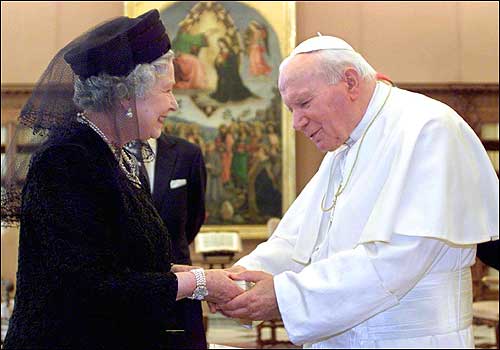
Queen with the PopeSo it's not the right time to sort out the cause of our doom-spiralling economy, high unemployment and high cost of living but it is apparently the right time to sort out the laws governing succession to the throne to allow the monarch to marry Catholics, girls to accede to the throne ahead of boys and to remove the requirement for the monarch to authorise royal marriages.

I wonder how many people have written to their MPs asking them to make these changes?  I reckon most MPs will have had somewhere in the region of zero letters about this and quite rightly so - it doesn't matter.

But the changes that are being made are.  The monarch is the head of the Anglican church, how can they marry a Catholic?  The changes require amendments to Act of Settlement and the Bill of Rights - I just don't trust the British government to make changes to the English constitution.  They're already talking about a British Bill of Rights and Responsibilities again, is this going to be used as an opportunity to do away with the English Bill of Rights and replace it with an inferior British alternative?

This is a pointless distraction, an unnecessary tinkering with the English constitution and a complete waste of time and money.

Cross-posted at: Wonko's World - EU referendum not a priority but line of succession is?