Showing posts with label Italy. Show all posts

Friday, 23 December 2016

Berlin lorry attacker shot dead by Italian police

Anis Amri, the man Tunisian behind the lorry attack on a Christmas market in Berlin, has been shot dead in Milan today.

Amri managed to travel undetected across Germany and through France and Switzerland to get to Italy thanks to the EU's open borders. He was eventually found in Milan where he got involved in a shootout with police and was shot dead by a newly qualified police officer.

Pictures of Amri have been published in Italian media showing him arriving in Italy posing as an asylum seeker in 2011. Shortly after arriving in Italy he burnt down a school and immigration reception centre and was locked up for 4 years. After being released from prison he wasn't deported but allowed to make his way to Germany where he was put on a danger list of suspected terrorists. He was arrested 3 times this year on suspicion of planning a terrorist attack but still wasn't deported.

Within minutes of being shot dead in Milan photos of his dead body were published in Italian media. A video of him pledging allegiance to ISIS was released by the group earlier today.

Monday, 5 December 2016

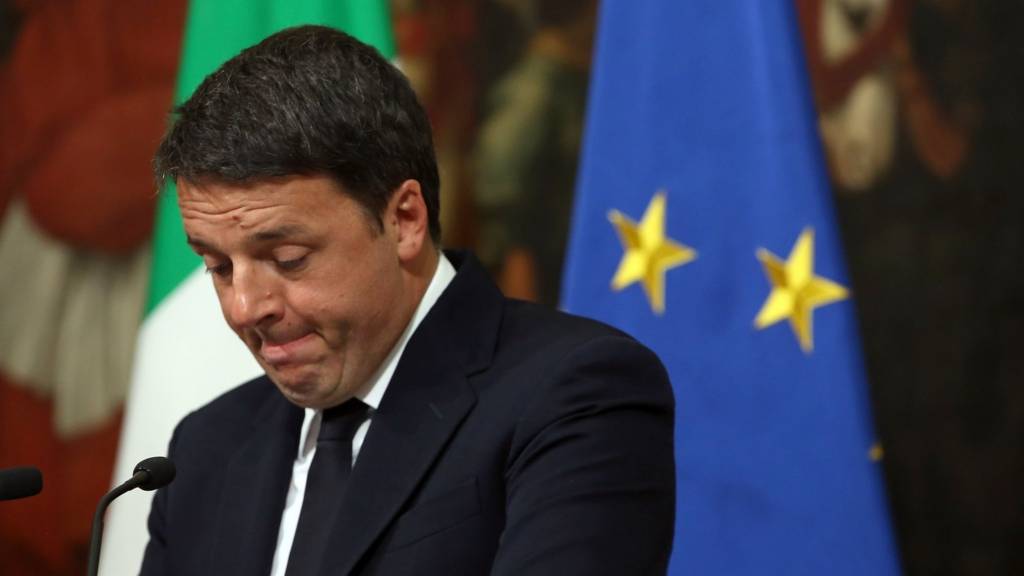
Italians vote down constitutional reforms, Renzi resigns

The Italian Prime Minister, Matteo Renzi, has resigned after Italians voted against his constitutional reforms by a wide margin.

Renzi had wanted to change the constitution to take most of the power away from the senate and hand it to the central government and to replace the directly elected members of the senate with appointments from regional assemblies. It would have made the Prime Minister and his government very powerful and upset the careful balance established by the post-facist era constitution whilst establishing the primacy of EU law in the Italian constitution. It's all a bit Blairite but that's hardly surprising as he has been compared to Blair since first rising to the top of the Italian Democratic Party.

With most polls counted the country is divided roughly 60/40 against the proposed constitutional changes on a 70% turnout and Renzi conceded defeat this morning. The Five Star Movement - UKIP's main partner in the EFDD group in the EU Parliament - is putting itself on a war footing in preparation for early elections next year but it is likely that the President (himself a member of the Italian Democratic Party) will appoint a caretaker government instead.

Italy's debt to GDP ratio is 133% which is second only to Greece amongst €urozone economies, their banks are teetering on the brink of collapse and unemployment is through the roof. This is a major cause for concern in the €urozone given that Italy is their third largest economy.

Monday, 29 June 2015

M5S present 200k signature to Italian Senate calling for €uro referendum

UKIP's partners in the EFDD group in the EU Parliament, the Five Star Movement, have presented a 200k signature to the Italian Senate calling for a referendum on membership of the €uro.

The petition calls for a referendum by January next year.


Monday, 4 March 2013

Italy heading for another unelected government

Things are hotting up in Italy again after president Giorgio Napolitano suggested a second unelected government, just a week after getting rid of Mario Monti's "technocrat" government.  The governor of the Bank of Italy has been suggested to run the country while the elected politicians try and form a democratic government.

The most vocal political opponent to the idea seems to be Beppe Grillo, a comedian turned politician who has unexpectedly found himself heading up 163 elected representatives without a plan or any infrastructure behind his party.  He says they "will vote law by law" rather than support any government but he does say that if his party gets into power they will put the country into technical default and withdraw from the €urozone.

Thursday, 21 June 2012

It's time to ban loans to €urozone countries

So, Greece has elected a pro-EU, pro-austerity, pro-bailout government again which will soon be implementing even more of the punishing EU-mandated austerity that led to riots earlier this year in return for increasing its crippling national debt. You can't make this stuff up.

Europhile politicians have declared the Greek result as a victory for "Europe" (they mean the EU but they don't acknowledge the existence of a Europe outside of the EU) and for the €uro.  What they refuse to accept, though, is that the result is irrelevant to the future of both the EU and the single currency.  The €uro will fail whether Greece is in it or not.  The Greece-shaped economic black hole in the €urozone is mere pocket money compared to France, Spain and Italy.


Spain is the fourth largest economy in the €urozone and they've just had to go cap in hand to the EU bailout fund to get their banks recapitalised.  The Spanish economy is in such a poor state that the yield on 10 year bonds (kind of like the interest rate on a loan) has tipped over 7% - that's the psychological barrier between moderate risk and high risk and Ireland, Portugal and Greece all crossed that line prior to collapse.  Cyprus, the €urozone country tipped to fall over next, is averaging almost 16% yields on 10 year bonds and has apparently been talking to the Russians about a loan to bail out one of its banks next week.


Spain is currently waiting for €100bn of capitalisation for its banks who have unexpectedly found that having entire towns of half-finished houses, toxic mortgages and billions of €uros of loans to bankrupt countries making up the bulk of their assets means that they might not be able to pay their bills which even more inexplicably seems to be putting institutional investors off the idea of loaning them even more money.  Spain is too big to be bailed out - there isn't enough money in the EU - which is why its banks are being bailed out directly by the EU bailout fund that is only supposed to be used to bail out countries.


Italian 10 year bonds are at just over 6% and we've yet to see the effects of Italian bank BNI freezing customer accounts for a month.  It's reasonable to assume we'll see a run on the bank when it unfreezes the accounts again and it's also reasonable to assume that as happened here with Northern Rock, a run on BNI could very well trigger the virtual collapse of the Italian banking system and force the Italian government to bail out its banks.  The big difference between a bailout of UK banks and a bailout of Italian banks is the cost - the British government is paying 4% interest on 10 year bonds, the Italian government is paying around 6%.  This might not sound like a big difference but it adds 50% onto the Italian government's cost of borrowing compared to the British government.  To put it into context, it cost £850bn to bail out RBS - with a 4% yield, that means the British government would have to pay back an extra £34bn on top of the £850bn in 10 years' time.  If the Italian government had borrowed £850bn at 6% they would be paying back £51bn on top of the £850bn - that's 3 times the GVA of Birmingham.

The €urozone is in terminal decline, UK banks need to call in their €urozone loans and the British government needs to ban any further high risk loans to €urozone countries to protect the economy from over-exposure to the €uro's imminent collapse.

Friday, 15 June 2012

Italian bank freezes all bank accounts for a month

News is quietly filtering out that Bank Network Investments SpA (BNI) in Italy has suspended all of its customers' bank accounts for a month amid financial difficulties.

The suspension was authorised by the Bank of Italy and a low key announcement was put on the BNI website a week ago.  It appears that the Italian media have conspired to keep a lid on the suspension, failing to report the announcement before the suspension came into force and is still trying to suppress the news two days later.

There were runs on Spanish banks last month which went largely unreported in the media as well.  It's pretty certain that the media - especially in the €urozone - is under orders not to report on anything that might further undermine the failing single currency and the tattered remains of its constituent economies.

Thursday, 14 June 2012

Nigel Farage on the insanity of the Spanish bank bailout

Nigel Farage doing what he does best: exposing the absolute insanity of the EU and the €urozone.  Italy is forced to borrow €100m at 7% interest on the open market to loan to Spanish banks at 3% interest and this is called an example of what a success the €uro has been!

Thursday, 1 December 2011

The game is up for the €uro


Nicolas Sarkozy has called for the EU to be "refounded" around France and Germany, saying "We must confront those who doubt the stability of the euro and speculate on its break-up with total solidarity".

The people openly speculating about the imminent break-up of the €uro now includes the Governor of the Bank of England, Mervyn King, who has told UK banks to start stockpiling cash and prepare for the €uro's demise.  He also warned about the amount of debts money the UK's banks have owed to them by companies in €urozone countries which aren't enough to bankrupt them but enough to make a dent in their reserves.

Sarkozy wants to ban countries from defaulting on their debts but stopped short of agreeing with Angela Merkel's suggestion that the EU should approve and regulate national budgets.

Merkel and Sarkozy are talking up the €uro and saying they're going to "guarantee" its future but the game is up and I think they know it.  Reading the words brings to mind images of leaders in the process of being overthrown going on TV to tell people everything is ok while TVs around the world are showing footage of revolutionaries storming their palace.

France - the EU's second largest economy - is at risk of losing its AAA credit rating over concerns that it might not be able to pay its debts.  Italy - the third largest economy in the EU - is on the brink of disaster.  We've seen two government's overthrown by the EU and sockpuppets put in their place.  The end of the €uro is nigh and perhaps the EU too, it's just a matter of timing.  It might last to the end of the year, it might be gone by Christmas - I don't think there is any doubt now that the €uro is beyond salvation.  The EU finance commissioner, Ollie Rehn, said yesterday that they have 10 days to save the €uro and the EU ... well, make that 8 now.

Camoron is heading for France tomorrow to talk to Sarkozy, I hope to god he doesn't do something stupid and drag us into the €uro's collapse.

Wednesday, 16 November 2011

Italian Cabinet to be 100% unelected

The EU's new man in Italy, Prætor Mario Monti, has appointed his first cabinet today.

Like Monti, all 17 members of the cabinet are unelected and all are academics and economists.  The Italians have had a nationalist, corporatist government in living memory which didn't exactly go well yet according to an opinion poll by the Piepoli Institute, 53% of Italians support an unelected technocratic government.

The EU has now deposed two democratically elected leaders and installed eurocrats in their place.  Lord Tebbit suggests that the EU would be quite happy to install Nick Clegg as PM here if Cameron forgets which side of his bread is buttered.

One of Angela Merkel's cronies, the nationalist socialist homophobe, Volker Kauder, says that the UK should fall into line and stop opposing the Tobin Tax which would devastate our economy.  If Cameron doesn't capitulate on the Tobin Tax, will we see an attempt to overthrow the British government and install the euro extremist Clegg in his place?

Thursday, 4 August 2011

Italy in pre-bailout talks with the EU, Cyprus could be next?

The Italian government has had talks with the EU about rising bond prices and the possibility it might not be able to finance itself out of recession.

Emperor Barroso has once again attacked the international credit rating agencies - Standard & Poor, Filch and Moody's - for not covering up the risk of lending money to eurozone countries.

The higher the risk of full or partial default on bonds, the lower the credit rating a country will get.  The lower the credit rating, the higher interest rate investors will expect on bonds.  The higher the interest rate, the more it costs the country issuing them to get some (relatively) short term cash.

Italian and Spanish 10 year bonds are attracting yields of just over 6% which is on the line between affordability and unsustainability.  Much higher and it's going to become too expensive to borrow on the bond markets and they're going to have to go cap in hand to ... well that's the problem, there isn't enough money to bail out either Italy or Spain, let alone both of them.

Italy's national debt (not including the hidden extras like pension liabilities and PFI) is 120% of GDP and corruption is rife at all levels of society - if Silvio Berlusconi didn't have immunity from prosecution as president, he would be in prison now for fraud and corruption.  Large parts of Italy are under the control of the Mafia who steal billions of euro of public money.  S&P, Moody's and Filch are damn right to consider Italy a risk to investors - they don't have enough money to pay their bills and what money they do raise through taxation is pillaged mercilessly by the Mafia.

And I wouldn't normally link to the communist rag, the Guardian, but they are leading with the story that Cyprus is now top of the list of contenders for the next bailout.  A few billion for Cyprus will take even more money out of the theoretical bailout fund making a bailout of Italy or Spain even more improbable.

Wednesday, 20 July 2011

The bond markets are rarely wrong - is Italy next?

Working on the principle that rich investors become rich by knowing where to invest their money, taking a look at the performance of bonds issued by eurozone countries gives a valuable insight into their economies.

Government bonds are like loans - investors effectively loan governments money by buying bonds which can be turned back into cash with a guaranteed amount of interest (the "yield") after a certain amount of time.  There is, of course, the ever-present risk that said government might find itself in dire financial straits and will default on the repayment of bonds when they mature.

Generally speaking, the risk of a government defaulting on bonds is tiny because if they need money they raise taxes or print more money (quantative easing).  But there is only so much money you can print before your currency becomes worthless and it costs a month's wages to buy a toilet roll like has happened in Zimbabwe and there is only so much people will pay in taxes before they start wondering what their leader's head would look like on a spike on the walls of that lovely big palace they live in.

Sometimes countries have no choice but to default on bond repayments because there simply isn't enough money to pay them - a situation Greece finds itself in now.  And it's because of these occasional defaults that investors expect a higher or lower yield on the bonds they are buying to reflect the higher or lower risk of not getting their money back.  This is no different to what happens in high street banks and just as there are credit reference agencies deciding on the credit worthiness of you and I, so there are credit reference agencies that decide the credit worthiness of countries and their bleak outlook on the economies of eurozone countries has lead to an EU proposal to censor them.

Using the information that the likes of Moody's and Standard & Poor produce and their own gut instincts, institutional investors offer to buy a certain amount of bonds at government bond auctions with a specific yield (interest rate).  The higher the yield, the higher the risk these people think there is of the country not being able to pay their bills and defaulting or of having to print so much money that they will devalue their currency so much that the bonds are worth less than they paid for them.  In the eurozone, countries can't just print their own money or devalue their currency because they're locked into the Franco-German controlled monetary union so a higher yield on a eurozone country's bonds is mostly based on their perceived ability to pay.

Ok, lesson over.  How are things looking on the European bond market?  Let's kick Greece while it's down: Angela Merkel is trying to play down hopes of a miraculous cure for Greece's financial problems and investors clearly agree - investors are asking for an average of 28% yields on 10 year bonds according to Trading Economics.  That means that for every million pounds the Greek government raises selling 10 year bonds, in 10 years' time they will have to pay back the original millon pounds plus £280,000.  Greece raised about €20bn by selling bonds at the start of last year - if it tried to raise that amount of money again at current prices, they'd be faced with a bill for €5.6bn in interest alone as well as the original €20bn sale price of the bond.

But it's not just Greece.  If you take a look at the big increases in yields over the last year, Ireland, Greece, Portugal, Italy and Spain top the list.  The UK and Norway have seen small decreases in the cost of borrowing and Switzerland has seen a very small increase - the UK is of course outside of the eurozone and Norway and Switzerland are outside of the EU altogether.  In fact, other than Austria, Sweden, Poland and the Czech Republic, the cost of borrowing has gone up across the eurozone while costs have decreased outside of it.  Belgium is high on the list of countries seeing the cost of borrowing increase by almost a third over the year and apparently presenting a higher risk to investors than, amongst others, serial bankrupt Japan and Thailand which is rumoured to be on the brink of another military coup.

If the bond markets are anything to go by, Italy is going to leapfrog Spain and be the next eurozone economy to fail.  That's certainly the fear the EU has at the moment - they held a meeting a few days ago to talk about a possible default in Italy.  Unfortunately for the people living in eurozone countries, there is no way out of the downward spiral into bankruptcy while they are tied into the EU's single currency.

Wednesday, 23 February 2011

Barroso wants to spread Libyan asylum seekers in Italy around the EU

The BBC reports the following comment by Emperor Barroso on the Italian government's concerns that they are about to be flooded by refugees from their former colony, Libya:

I think if this problem develops that way, we have to be ready to do it in a European way, because these people are not just trying to come to Italy. We have to prepare a response that is compatible with our values.
As is always the case with Emperor Barroso, you have to look at what he's not saying to get the true meaning.  What he means when he says "we have to be ready to do it in a European way, because these people are not just trying to come to Italy" is that Libyans seeking refuge in Italy will be spread around the EU, not dealt with in the first friendly country they land in as international law requires.

This is yet another example of the EU acting like a country.  What is happening in Libya is appalling but we mustn't allow it to be used as an excuse for EU empire building.  International law requires asylum seekers to be taken in by the first friendly country they land in.  Libyans have the whole Mediterranean coast - European and African - to choose from, they don't need to end up here.

Monday, 10 January 2011

Two down, three to go: Portugal is next

Back in November, the Republic of Ireland came under pressure from France and Germany to accept an illegal bailtout from the EU.  Ireland, of course, said it didn't need a bailout and that it was worried about the loss of sovereignty associated with mortgaging the country to the EU but what little faith investors had left in the Irish economy was undermined and a week later they accepted a €100bn loan from the EU (including several billion from the UK) and IMF.

The required changes to the Lisbon Treaty to make bailing out member states legal have been made (another broken promise by Cast Iron Dave) paving the way for the next bankrupt Eurozone country to be bailed out.  Greece has already had €110bn from the EU and IMF, the Republic of Ireland has had £100bn and next on the list is Portugal who will be taking €80bn.

Portugal says that it doesn't need a bailout (like Ireland said) but France and Germany are trying to pressurise the Portuguese government into taking a bailout sooner rather than later (like they did to Ireland).  The French and German stock markets fell by about 1 and a half percent each and the FTSE fell half a percent on the news and the Americans are fretting about the risk of European sovereign debt.

Portugal is going to try to sell €1.25bn of bonds on Wednesday to get its hands on some cash and the interest rates are expected to be high.  Bonds are basically a type of loan taken out by governments from private markets with a guaranteed amount to be paid back on a specified date (assuming the country issuing the bonds doesn't default like Greece did).  The amount of interest investors demand on the bonds is an indication of the risk - if they think there's a chance the bonds will be defaulted on then they will demand a higher percentage rate, just like a high street bank does based on peoples' credit ratings.

On Thursday, Spain and Italy (the other two bankrupt PIIGS countries) will issue their own bonds to try and raise cash and how well they do will depend on Portugal's bond issue on Wednesday.  The ECB will probably buy more Portuguese bonds (it's already been buying up Greek, Portuguese and Spanish bonds to try and encourage investors) but as the ECB is the central bank of the failing Eurozone, it's a mystery how they expect investors to be reassured by their purchase of potential toxic bonds from the bankrupt PIIGS countries using their own money!

The order of the fall of the PIIGS has already predicted - "Portugal, Spain and Italy will be next" - Portugal will be bailed out in the next couple of weeks and then Spain will follow shortly thereafter.  Or will it?  Can EU member states (or the IMF for that matter) afford the €250-300bn it will cost to bail out Spain?  Will Spain be the straw that breaks the kamel's rücken and leads to Germany pulling the plug on the Euro?

The EU's political elite will defend the Euro and the EU project to the bitter end but the money will run out soon and Germany has been lucky so far to have pretty much escaped the consequences of the collapse of two Eurozone economies.  Next time they might not be so lucky and when the impending collapse of the Euro starts to hit Germans in the pocket they will be out of it.

Friday, 24 September 2010

5m new EU citizens

The Bulgarian Minister for the Diaspora, Bozhidar Dimitrov, has announced that up to half a million Bessarabians are expected to take advantage of a change in the law to give them Bulgarian citizenship.

Over 17,000 ethnic Bulgarians living in Moldova and Ukraine have already been given Bulgarian passports, allowing them to live and work anywhere in the European Empire.  An additional 300,000 ethnic Hungarians living in Serbia will be allowed to apply for Hungarian passports in 2011 and Romania has been handing out passports to Moldovans.

Spain, Italy and Portugal have all been handing out passports to the children and grandchildren of émigré, most of which live in Latin America and the Caribbean.

This wouldn't be a problem, of course, if the recipients of these new passports stayed in the country that had so generously granted them but of course they don't.  They make their way to the richer western European countries where they have the right, as EU citizens, to live and work, to claim benefits and to receive any services the "natives" are entitled to.  It doesn't matter that we don't have enough houses or jobs to meet the demands of people already living here, every one of the estimated 5m new EU citizens will have the right from the day they get their passport has been given the right by a foreign government we have no control over to live and work here.

The way things are going, they'll be giving away EU passports for 4 Weetabix tokens and a £5 postal order.

Thursday, 2 September 2010

Libya demands €5bn from EU

Colonel Gaddafi has demanded £4.1bn off the European Empire to stop illegal immigration from Libya.

Gaddafi used a visit to Libya's former colonial ruler, Italy, to make a speech calling for the Italians to convince the European Empire that they need to give him €5bn to counter "the risk of [Europe] turning black from illegal immigration".

Whilst in Rome, Gaddafi hosted a "Convert to Islam" party which was attended by 500 models, some of which were rented from an escort agency.  The Vatican weren't particularly impressed with Gaddafi using their back yard to recruit more victims and neither is our own Nigel Farage:
This is blackmail from a delusional dictator. It is outrageous that after calling for us all to convert to Islam, he is now threatening to send us Africa’s poor benighted masses.
Gaddafi is an unelected dictator, a racist, an Islamist and now he's demanding money with menaces.  Will our spineless masters in Brussels tell him to bugger off or meekly hand over the money?  I think we all know the answer.