Showing posts with label Leaders Debates. Show all posts

Friday, 17 April 2015

Opposition Leaders' Debate

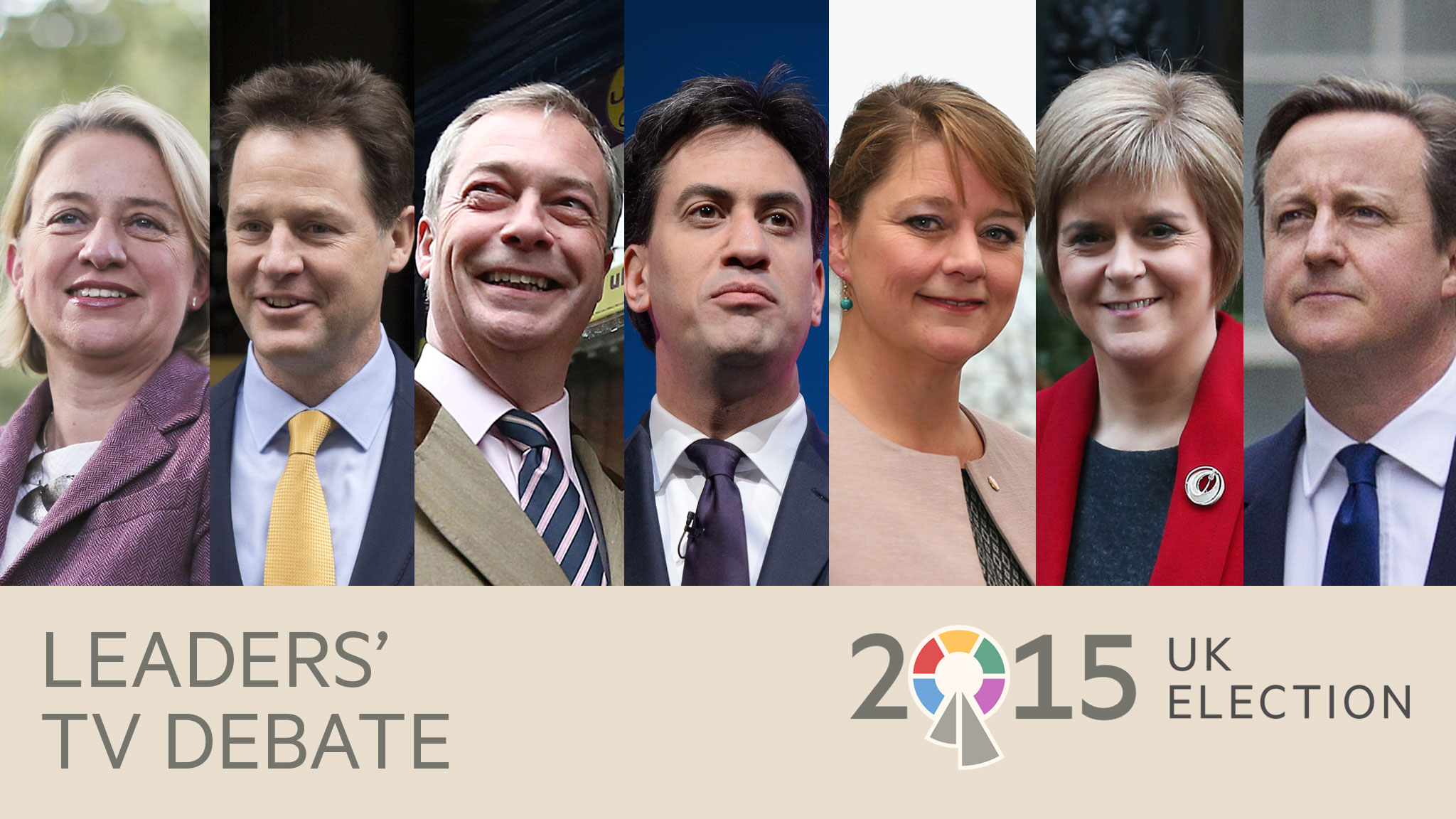
Nigel Farage put in a superb performance on last night's opposition leaders' debate on the BBC in the face of an extremely biased audience.

Farage got the first applause of the debate but it quickly became clear that the cheering and applause was largely reserved for the SNP, Greens, Labour and even Plaid. At one point Farage said that the audience was biased and was met with heckling from the audience and an unexpected admission from David Dimbleby that the audience had been "carefully selected" by a polling company to reflect the political balance of the panel which was, of course, all socialist with the exception of Nigel Farage.

It's a little difficult to get any real meaning from Survation's snap polling after the debate because of the presence of the SNP's Nicola Sturgeon who is only relevant in Scotland but whose Tory bashing and magic money tree economics made her very popular. It's clear that Nigel Farage came out very well from the debate, even with the SNP skewing things, it's just not possible to tell how well because of the inclusion of the Scottish and Welsh nationalists. What we needed was an England-only leaders' debate like the Scottish and Welsh only debates they're having in Scotland and Wales but the BBC would never do that.

Although Farage did very well in the polls he would undoubtedly have done better if it was an England-only panel and only people in England were surveyed. The Survation and other polls make interesting reading but they were a bit irrelevant.

Friday, 3 April 2015

Fantastic Mr Farage outfoxes the opposition in ITV leaders' debate

The first proper leaders' debate is done and dusted and Nigel Farage gave the performance we all expected - credible, honest, forthright and a controversial comment thrown into the mix.

By half time Farage was narrowly leading the official ComRes poll which prompted a change of tactic by Cameron, Miliband, Clegg and Sturgeon who started hogging all the time in the second half. Cameron barely said a word during the first half but he certainly had a lot to say when the polls showed Farage was in the lead!

It was all plain sailing for Farage until he made his trademark controversial comment, saying that people who aren't British citizens and are diagnosed with HIV shouldn't be treated for free on the NHS. He took a dip in the poll after that comment and ended up joint first overall with Cameron and Sturgeon.

But his comment was only controversial because he was the only one with the balls to say it. He's right to say that someone who isn't a British citizen and hasn't contributed to the NHS shouldn't be entitled to free treatment on the NHS at a cost of £25k per year for the rest of their lives. Of course it's very sad when someone gets an awful disease like HIV, it will be devastating to them and their families and they will naturally want to get the best medical treatment they can to prolong their life. But that can't be at the expense of saving the life of someone who is a British citizen and has paid into the NHS. It is morally indefensible to refuse life saving treatment to a 70 year old with cancer who has worked and paid taxes here all their life because it's too expensive and then spend £25k a year on retroviral drugs for a newly arrived immigrant with HIV.

Farage put in a great performance, the eminently forgettable lady from Plaid came a very convincing last place in all the polls, almost everything Nathalie Bennet from the Green Party said was just insanity, Nicola Sturgeon came across very well promising everything for free as only the leader of a nation that doesn't have to pay its own bills can. Clegg was pretty calamitous, Miliband kept staring into the camera as his PR guru had obviously been coaching to do and Cameron just kept banging on about his "plan" which is apparently "working". Obvious political bias aside, Farage won it for me.


Thursday, 5 March 2015

Yellow Belly Dave still trying to bottle out of leaders' debates

David Cameron is still trying to bottle out of TV debates, telling the broadcasters that he will only take part in one pre-election debate with at least seven party leaders.

Yellow Belly Dave is refusing to take part in head to head debates with Ed Miliband but offers no reason why, instead whining about the TV companies organising the debates themselves after he refused to co-operate.

If Cameron is refusing to co-operate then the TV companies should revise the format and have one debate with the minor and regional parties - SNP, Plaid, DUP, Greens and Lib Dems - and one with the mainstream parties - Conservatives, Labour and UKIP. If Cameron refuses to turn up then they should just empty chair him.


Friday, 17 October 2014

Cameron bottles leaders' debates

David Cameron is trying to bottle out of appearing on leaders' debates with Nigel Farage before next year's elections.

Cameron is using the excuse that it's not fair that the leader of the third largest party in the UK that won this year's EU elections and has elected representatives in all four home nations and at every level of government should get a place in the debates when the leader of the Green Party doesn't.

Whether the leader of the Green Party should get a place in the debates or not is debatable. They're challenging the Lib Dems for fourth place but that's more of a reflection on the Lib Dems than the Greens.

Cameron is pretending he's standing up for principals but really he's just scared to share a stage with Nigel Farage. We've had Bottler Brown, now we've got Decanter Dave.

Remember when David Cameron accused Gordon Brown of being a bottler in 2009?

Monday, 13 October 2014

Farage offered place in one leaders debate

Nigel Farage has been offered a place on one of the three planned Leaders' debates ahead of next year's general election.

The format agreed by the broadcasters is one debate with the leaders of the four largest parties, another with just the first, second and fourth largest parties (Tories, Labour and Lib Dems) and then a final one just before the election with just Cameron and Miliband to perpetuate the myth of two party politics.

While this is a step in the right direction, this kind of gerrymandering just isn't acceptable. Nigel Farage needs to be in all three debates, not just one.


Wednesday, 2 April 2014

Farage destroys Clegg in EU debte

Tonight's EU debate between Nick Clegg and Nigel Farage was even better than last weeks with a cool, calm and collected Farage wiping the floor with a discredited, desperate Clegg.

Clegg made very few attempts to defend our membership of the EU, spending most of the hour-long debate making bizarre personal attacks on Farage.

The post-debate polls say it all:

YouGov: 68% Farage, 27% Clegg

Guardian: 69% Farage, 31% Clegg

Sky News: 76% Farage, 24% Clegg

We'll leave you with Nigel Farage's final words from the debate: Come and join the people's army. Let's topple the establishment who got us into this mess.

Tuesday, 1 April 2014

It's almost time ...


Friday, 21 February 2014

Clegg -v- Farage


Nick Clegg has challenged Nigel Farage to a debate on the LBC radio station on whether we should stay in the EU or leave.

Farage has raised the stakes and told Clegg to get Cameron and Miliband on as well and make it a proper leaders' debate.

Even though Nigel Farage is the most popular party leader (on the odd occasion polling companies ask) and most people in the country want out of the EU, a debate on LBC would still be a tough gig because it's a London radio station and support for the EU and unfettered immigration runs high in a city where only 45% of the population are "white British".

That said, any credibility Nick Clegg might have had in an EU debate is destroyed by the fact that as a former EU commissioner he is obliged to promote the EU at all times and never to criticise the EU or its institutions publicly or he will lose his EU pension. And that's before you get onto his vacuous claims about millions of jobs and world peace relying on the EU.

Nigel Farage will undoubtedly wipe the floor with Clegg on the EU and any other topic for discussion that comes up because both Clegg and the Lib Dems are wrong on pretty much everything, as evidenced by their rapid decline into obscurity in opinion polls and at the ballot box. Although it would be nice to hold out for the other two europhile leaders to get in on the act it's not going to happen because whilst Clegg has nothing to lose, being about as popular as a dog poo sandwich, it would be electoral suicide for the other two to try and debate Nigel Farage. By saying no to a one on one with Clegg in the hope that Cameron and Miliband will join in, Farage will look weak. He should accept the offer, wipe the floor with Clegg and use Clegg's rare show of backbone to shame Cameron and Miliband into live televised debates with the three main parties plus the Lib Dems.

There is a poll on the LBC website on who you think would win the debate between Clegg and Farage. It's a fairly close-run thing but Farage is out in front at the moment.

Friday, 18 January 2013

Farage tells Cowardly Cameron not to book himself any studio time

Responding to Cowardly Cameron's pronouncement that the leader of the UK's third (and fastest growing) party shouldn't be allowed to take part in any televised leaders' debates before the next election but the leader of the fourth party should, Nigel Farage had this to say:
If he wants to restrict it to those parties who are likely to form the next government, he’d better not be booking studio time himself.
Quite.  Meanwhile, someone has started a petition on the HM Government e-petitions site for UKIP to be included in any televised debate and it's trending already.


Tuesday, 27 April 2010

UKIP to seek injunction against BBC

Lord Pearson has written to the BBC warning them that UKIP will be seeking an injunction requiring them to give equal billing to Lord Pearson in the Leaders' Debate on Thursday. The text of his letter is as follows:
Leader's Office
United Kingdom Independence Party
Room 230
10 Greycoat Place
London SW1P 1SB
Mark Thompson, Esq.,
Director-General,
British Broadcasting Corporation,
White City,
201 Wood Lane,
London W12 7TS.
27 April 2010
Dear Mark,

Proposed claim for judicial review

I wrote to Sir Michael Lyons at the BBC Trust on 22 December, asking that UKIP should be allowed to participate in the televised debates between party leaders. Sir Michael wrote explaining that you rather than the Trust were the appropriate point of contact, and you wrote to me on 15 January 2010, conveying to me your decision and that of the BBC to reject my request on the following grounds:

"The basis on which judgements are made about relative levels of coverage rests on past and current electoral support. For the election to the House of Commons in 2010, the starting point is the last General Election, in 2005. Similarly, the starting point for coverage of the 2009 European election was the previous European election of 2004. This means that UKIP - on the basis of its strong performance in 2004 - was given the same level of coverage in the 2009 election as the Labour, Conservative and Liberal Democrat parties. In 2005, however, at the last General Election (notwithstanding its performance at the European election less than a year before), UKIP attracted just over 2% of the vote and won no representation at Westminster.

"It is, therefore, appropriate and consistent for the BBC - and other broadcasters - to offer the opportunity to take part in the Prime Ministerial debates only to those parties which have substantial electoral support in the context of Westminster. There will be additional opportunities across the BBC for other parties to receive appropriate coverage responding to the Prime Ministerial debate."

We have been given no adequate opportunity to respond to the first two debates. What arrangements is the BBC making to address this? How can the coverage be "appropriate" if we cannot reach the leaders' audience?

The first two of the party leaders' debates have been held and, as I feared, have given spectacular prominence to the three parties whom you, ITV and Sky TV allowed to take part. The unfairness in our being excluded from the party leaders' debates is now all too evident.

Most recently, I wrote to you on 23 April, sending you my recent correspondence with Sky TV, and inviting you to rectify the lack of impartiality which broadcasters have demonstrated in refusing to allow UKIP to participate in the televised leaders' debates. I have not had a reply to my letter to you. The final leaders' debate is in just two days' time. The matter is now urgent, and I have done my best to pursue it timeously.

Since time is now short, I have taken advice, in the light of which I should like to draw your attention to the following provisions in the BBC's own election guidelines:

"3. Due Impartiality in coverage of parties and issues

"3.1 Coverage of the Parties

"To achieve due impartiality, each bulletin, programme or programme strand, as well as online and interactive services, for each election, must ensure that the parties are covered proportionately over an appropriate period, normally across a week. This means taking into account levels of past and current electoral support.

"Due impartiality must be achieved within these categories:

"clips;
"interviews/discussions of up to 10 minutes;
"longer-form programmes.

"Previous electoral support in equivalent elections is the starting-point for making judgments about the proportionate level of coverage between parties.

"However, other factors can be taken into account where appropriate, including evidence of variation in levels of support in more recent elections, changed political circumstances (e.g. new parties or party splits) as well as other evidence of current support. The number of candidates a party is standing may also be a factor." [my emphasis]

These election guidelines - as you may know - were approved by Jenny Watson, the chairman of the Electoral Commission, in a letter dated 11 January 2010 to Ric Bailey, the BBC's Chief Adviser for Politics (Editorial Policy), as follows:

"In addition we are satisfied with the draft Election Guidelines, and the approach taken regarding the participation of candidates in constituency items during the election period."

In the last "equivalent" election, the 2005 General Election, UKIP won 2.2% of the national vote, as you have pointed out. However, in the more recent European Election of last year, UKIP came second in the UK, with 16.5% of the national vote, compared with 15.7% for Labour and 13.7% for the Liberal Democrats. This surely constitutes compelling "evidence of variation in levels of support in more recent elections". In the circumstances, I should have expected your correspondence to have referred to this provision within your election guidelines. You have allowed Labour and the Liberal Democrats to participate in the leaders' debates, though they received smaller shares of the vote than UKIP in the most recent test of national opinion, which was the European Election of last year. Yet you have denied UKIP the chance to participate.

Furthermore, UKIP - as of today - is fielding 560 candidates, a number not far short of those fielded by the three parties whom you are allowing to participate in the leaders' debate. As your own guidelines say, "The number of candidates a party is standing may also be a factor." I should have expected your correspondence to have referred to this provision of your electoral guidelines too. Certainly, UKIP - in the number of candidates we are fielding in this General Election - is close to parity with those parties whom you are allowing to participate.

Both these circumstances are directly relevant to any decision whether to allow UKIP to participate in the leaders' debates. Yet you do not seem to have taken account of them in your decision as conveyed to me, or in any of our subsequent discussions.

There is also the question of the BBC's obligations under its charter, which has been the subject of correspondence between us on many previous occasions. In the leaders' debate so far, the question of our EU membership, its lack of democratic accountability and its heavy financial and constitutional cost has not been debated at all. Mr. Brown has been allowed to get away with saying, unchallenged, that three million jobs depend on our membership of the European Union. Nor has there been any discussion of our proposal to introduce binding initiative referenda at local as well as national level, which is the only effective way to allow us, the people, to rule once more, as well as to address the issue of corruption in Parliament, to say nothing of the increasing gulf between government and the governed.

It is reasonable and proportionate, having regard to the election guidelines as cited above, and having regard to the absence of UKIP from the first two leaders' debates, that UKIP should be allowed to participate fairly and fully in the final leaders' debate.

Since you did not adopt my original suggestion that UKIP should at least be allowed to participate in some part of each debate, and since all other avenues available to me have been exhausted, and since UKIP has been denied the opportunity to participate at all in either of the first two debates, and since time is running out, I must now ask you to reconsider your refusal to allow UKIP to participate in the third and final leaders' debate, to be aired on Thursday evening, 29 April 2010.

Should you and the BBC fail to accede to this request by noon tomorrow, Wednesday, 28 April, 2010, please take this letter as notice, in terms of the pre-action protocol in judicial review proceedings under the Civil Procedure Rules, that the United Kingdom Independence Party, of PO Box 480, Newton Abbot, Devon, TQ12 9BG, and I as UKIP's leader, as claimants, will apply to the Administrative Court at or as soon as practicable after 2 pm tomorrow afternoon for judicial review of your decision and that of the BBC, as defendants, expressed in your letter to me of 15 January 2010, to refuse to allow UKIP to participate in the third and final leaders' debate, and for an injunction requiring you and the BBC to permit me, as UKIP's leader, to participate in that debate on an equal footing with all others whom you and the BBC shall have permitted to participate.

I regret that the notice is very short, but time is pressing and I have not had an answer to my letter to you of 23 April.

Details of our legal advisers will be notified to you in due course. In the meantime, any reply and any court documents should be sent to me at the address below:

The Lord Pearson of Rannoch,
Leader's Office,
United Kingdom Independence Party,
Room 230,
10 Greycoat Place,
London SW1P 1SB.

Yours sincerely,

[signed] Malcolm

Lord Pearson of Rannoch
Of course the BBC will argue that the EU elections aren't equivalent to a general election and to a certain extent they are correct.  However, their own guidelines specifically say that past election results are a starting point.  UKIP's support has risen significantly since the last general election and the EU election results last year back that up - they may not be equivalent elections but electoral success on the scale that UKIP achieved wouldn't be possible without a general increase in support for UKIP.

UKIP has representation in all four home nations which is something only the Tory wing of the LibLabCon can claim.  UKIP is also standing 560 candidates in the general election. The BNP are standing 339 and the Greens about the same amount.  UKIP is head and shoulders above any of the small parties and set to make the biggest gains from the three failed parties.

The BBC have been inconsistent with their election coverage.  In some areas, all candidates have had equal billing and in others - Shropshire, for instance - the non-LibLabCon candidates have been virtually ignored.  I made two complaints to BBC Shropshire about the LibLabCon candidates being described as "the candidates" when their election programmes were being introduced or promoted when they are actually only half of the candidates.  The producer conceded the point on the second occasion and said he would issue revised guidance to staff but the BBC still present it as a three-horse race, they just slightly change the way they say it.

It's ironic that the BBC, which is left wing to the core, should actively seek to give an unfair advantage to the privileged and powerful LibLabCon who already have all the publicity, politicians and state funding at the expense of the non-LibLabCon parties such as UKIP who are deprived of publicity and no state funding and suffer as a result.  But then perhaps in the eyes of the BBC all political parties are equal but some are more equal than others?